
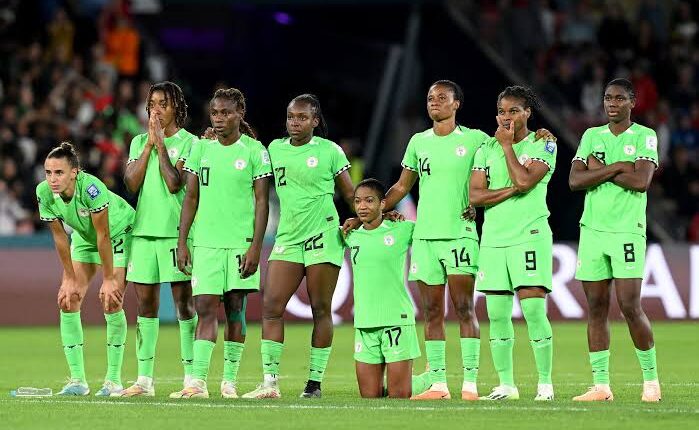
The Super Falcons’ performance at the 2024 Olympic Games in Paris has raised concerns, echoing a similar disappointment from the 2008 Beijing Olympics. Despite hopes for a strong showing, Nigeria’s women’s football team exited the tournament in the group stage, mirroring their early departure 16 years ago.
In 2008, the Falcons struggled in a tough group, losing narrowly to North Korea and Germany before a 3-1 defeat to Brazil sealed their fate. The 2024 Games saw a repeat, as Nigeria was drawn into a challenging group with Japan, Brazil, and Spain—the reigning champions of Asia, South America, and the world, respectively. Despite initial optimism, the team suffered a 1-0 loss to Brazil, another 1-0 defeat to Spain, and a final 3-1 loss to Japan, ending their Olympic campaign prematurely.
Japan’s early goals and a stunning free kick extinguished Nigeria’s hopes of advancing, despite a brief glimmer of hope provided by Jennifer Echegini’s goal. The Falcons’ inability to capitalize on their opportunities, combined with a lackluster defensive strategy, was evident throughout the tournament.
The Super Falcons’ performance in Paris stood in stark contrast to their showing at the 2023 FIFA Women’s World Cup, where they advanced to the knockout stage and earned global admiration. However, in Paris, the team appeared predictable, disjointed, and ineffective, particularly in their offensive play.
A major issue identified was the team’s lack of goal-scoring prowess. Despite having talented forwards like Asisat Oshoala, Rasheedat Ajibade, and Uchenna Kanu, Nigeria struggled to find the back of the net, managing only one goal in three games. This deficiency was not due to a lack of chances but rather an inability to convert them, a problem that has plagued the team from the World Cup through the Olympic qualifiers and into the Games.
Criticism also fell on Coach Randy Waldrum for his tactical decisions, particularly his choice of players and their positions. Questions were raised about his selection of Chidinma Okeke, a right-back, to play on the left, despite her known struggles in that position. The absence of natural left-footed players like Imuran and Glory Ogbonna, who had shown promise, further compounded the team’s defensive woes.
Waldrum attributed the team’s poor showing to inadequate preparation, citing missed training opportunities due to visa issues and a short camp in Spain. However, former Super Falcons coach Kadiri Ikhana pointed to deeper issues, including the team’s overly defensive approach and the quality of opposition in their group. Ikhana argued that the Falcons should have played their natural game rather than focusing solely on defense, which allowed their opponents to dominate.
As the team looks ahead, calls for a change in coaching and the introduction of younger, hungrier players are growing louder. Critics argue that Nigeria’s football authorities should invest in developing local coaching talent and regularly provide training to ensure the national team is better prepared for future challenges. The disappointing Olympic campaign has made it clear that significant changes are needed if the Super Falcons are to regain their former glory.