
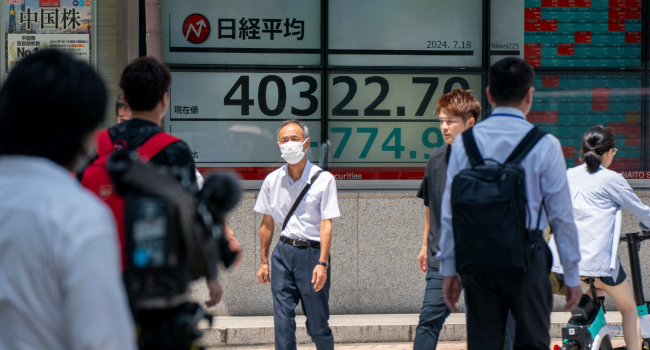
Asian markets fell Monday following Joe Biden’s decision to drop out of the US presidential race, which has introduced new uncertainty for investors. This overshadowed China’s recent interest rate cuts aimed at revitalizing its struggling economy.
Biden announced his withdrawal on Sunday after weeks of calls for him to step aside due to a poor debate performance that raised concerns about his health. He endorsed Vice President Kamala Harris to succeed him.
This development comes in the wake of an assassination attempt on Donald Trump and the Republican convention, which increased bets on Trump’s victory in the upcoming November election. Investors are now trying to understand the implications of Biden’s decision and the potential impact on market conditions.
Market analysts predict increased volatility in the near term. Ray Attrill of National Australia Bank noted that the news adds uncertainty to the November 5 election outcome and that it will take weeks to determine the race’s new dynamics.
Stocks in Asia dropped Monday following losses on Wall Street and in Europe. The decline was partly due to a global computer system crash caused by a faulty antivirus update, affecting various sectors including airports, airlines, trains, banks, and healthcare.
Major markets in Tokyo, Shanghai, Sydney, Seoul, Singapore, Taipei, Mumbai, Wellington, and Manila all saw declines, though Hong Kong experienced gains thanks to strong performance by Chinese tech firms. European markets in London, Frankfurt, and Paris opened higher.
Stephen Innes commented in his “Dark Side Of The Boom” analysis that the political uncertainty has left investors scrambling to make sense of the new landscape.
These political developments have overshadowed positive expectations for interest rate cuts by the Federal Reserve, which could occur as soon as September, with further reductions possible by January.
China’s central bank recently lowered its one-year and five-year loan prime rates to encourage more lending, as the country faces economic challenges from a significant property crisis and weak consumer demand. Despite this move, there was little market reaction.
The Chinese government has also pledged to address local government debt through tax reforms, following a meeting of leaders last week that offered few major announcements but emphasized addressing economic risks. Concerns about local government finances have been exacerbated by the real estate debt crisis, leading Fitch Ratings to downgrade China’s sovereign credit outlook in April.
 News Editor
  Hyelsinta Hassan