
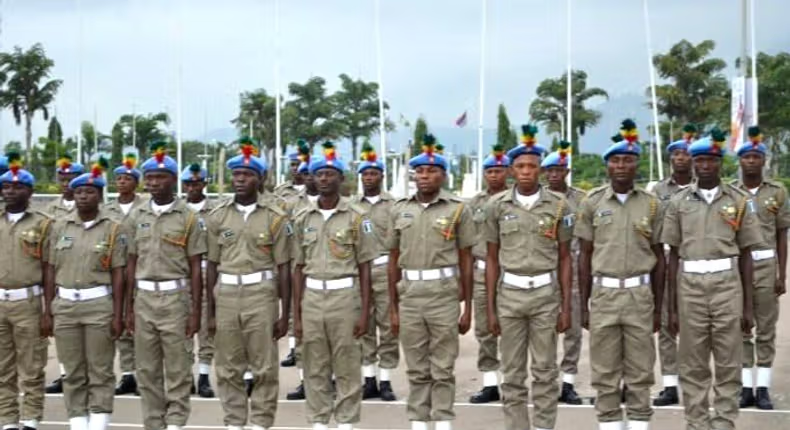
Founded in 1998 by Dr. Dickson A. O. Akoh, the Nigerian Peace Corps (NPC) aims to engage young Nigerians in nation-building and community service. Unlike traditional paramilitary organizations like the Army or Navy, the Peace Corps operates under a different funding model and salary structure.
Ranks in the Nigerian Peace Corps:
The Peace Corps follows a hierarchical structure with unique ranks, including:
- Commandant General (CG): Highest rank, featuring one NPC arm, two stars, and one eagle.
- Deputy Commandant General (DCG): One NPC arm, one star, and one eagle.
- Assistant Commandant General (ACG): One NPC arm, one NPC bar, and one eagle.
- Commandant (CN): One NPC arm and one eagle.
- Deputy Commandant (DCN): One NPC arm and one star.
- Assistant Commandant (ACN): One NPC arm.
- Chief Superintendent (CSN): One star and one eagle.
- Superintendent (SN): One eagle.
- Deputy Superintendent (DSN): Three stars.
- Assistant Superintendent 1 (ASN 1): Two stars.
- Assistant Superintendent 2 (ASN 2): One star.
- Inspector 1: Three metal bars.
- Inspector 2: Two metal bars.
- Inspector 3: One metal bar.
- Corper Assistant 1 (Corper 1): Three wool bars.
- Corper Assistant 2 (Corper 2): Two wool bars.
- Corper Assistant 3 (Corper 3): One wool bar.
- Private Corper: One empty wool bar, the lowest rank.
Salary Structure:
The Nigerian Peace Corps does not receive government funding like other paramilitary organizations. Instead, it relies on donations, grants, and endowments. Consequently, salaries in the Peace Corps are generally lower than those in the Army, Navy, and Air Force. Members receive stipends, which are supplemented by benefits such as uniforms, kits, and honoraria for participating in events.
Membership Categories:
- Permanent Staff Officers: Typically unemployed youths with at least a Secondary School Certificate Examination (SSCE). They receive monthly stipends and references for future employment.
- Peace Corps Volunteers: Employed professionals who volunteer their services. They do not receive salaries but are provided with uniforms, kits, and honoraria.
- Student Members: Students who participate voluntarily in Peace Corps activities, gaining leadership and community service experience.
Functions of the Nigerian Peace Corps:
- Enlisting and training youths to support social order and public safety.
- Providing intelligence to security agencies.
- Promoting peace education and conflict resolution.
- Securing educational institutions from social vices.
- Engaging in community services such as crowd control and emergency relief.
The Nigerian Peace Corps plays a vital role in community development and social order. Despite its distinct funding and salary structure, it offers valuable opportunities for personal and professional growth.