
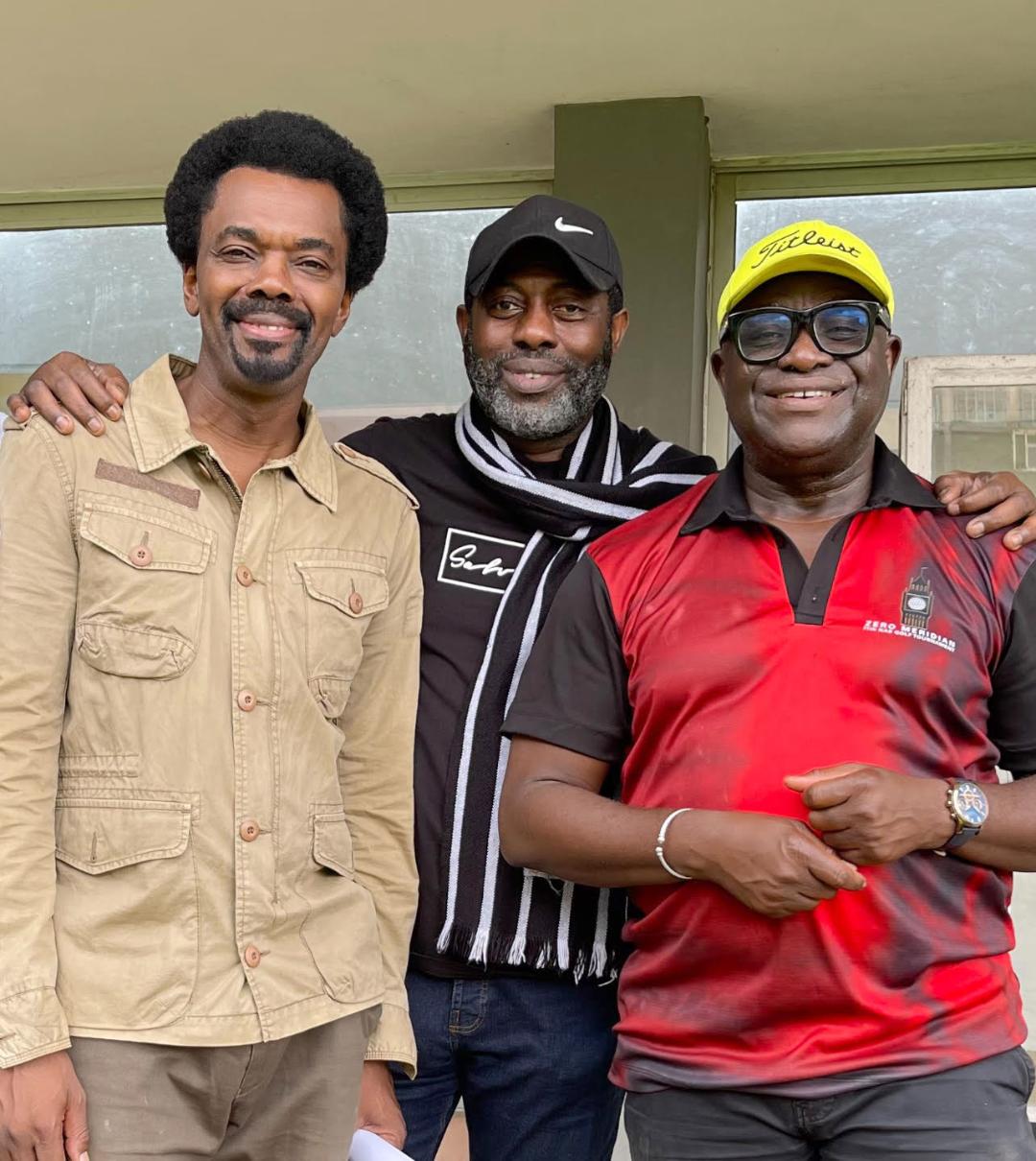
Professor Awam Amkpa has never hidden his admiration and love for Professor Wole Soyinka, his former teacher, who turns 90 on July 13. Given his background, Amkpa is naturally suited to direct the film adaptation of the Nobel Laureate’s critically acclaimed prison memoir, “The Man Died,” whose much-awaited premiere coincides with Soyinka’s birthday.
When Amkpa decided to take on the challenging task of directing the movie adapted from a text many find complex, emotive, and introspective, it was clear he was in his element. And he has indeed made a success of it.
Many who admire the Nobel Laureate for his literary exploits and activism are eagerly anticipating the biopic’s cinema release, hoping it will evoke poignant memories.
This project is undoubtedly Amkpa’s moment of glory—a rare opportunity for him to shine on the global stage as an accomplished dramatist.
The facts speak for themselves. Amkpa is an award-winning multifaceted artist, playwright, and director. He was Soyinka’s former student at the University of Ife (now Obafemi Awolowo University) and has dedicated much of his adult life to researching and upholding Soyinka’s principles. “Prof was always part of my adult life,” Amkpa reveals, offering a glimpse into the making of the movie.
Amkpa, who teaches drama, film, and cultural analysis at New York University in Abu Dhabi, where Soyinka also teaches, has leveraged his extensive knowledge and close association with the writer to bring fresh perspectives to the film.
“Most people read everything Prof writes just on his terms. But for me, it opens the window into what kind of mind conjures up this kind of thinking and how it goes through different kinds of stuff. I was fascinated by that. So when I read ‘The Man Died,’ it opened up windows into how he synthesized that experience, how he dealt with the emotions, and how he externalized those emotions to become what he wrote,” Amkpa said.
Narrating his approach to directing the movie, Amkpa referenced a story Soyinka had told about a female nurse who defied a soldier in a traffic jam—an act of bravery that mirrored Soyinka’s own fight against tyranny.
“So you can see that by honoring the act of defiance of that woman, whom they just saw in a traffic jam and how she fought back the soldiers, that became almost like a microcosm of him and the system—the act of refusal to allow tyrants to get away. We used it as a template introducing his recognition of acts of defiance. It is more like the human impulse to refuse tyranny. And that is what it is. That woman’s act was amazing, as a subtext to his defiance and incarceration,” Amkpa explained.
Amkpa offered a fresh perspective on “The Man Died,” which goes beyond Soyinka’s experience as a political prisoner during the Nigerian civil war in the late 1960s, portraying it as a systemic commentary on Nigeria at the time and the impulse that drove Soyinka’s activism and defiance.
“He (Soyinka) wrote that book not as a memoir of himself but as a memoir of defiance to a system. So it was not really about Wole Soyinka per se. It was about Nigeria and so on. It would be wrong to see ‘The Man Died’ as an exclusive memoir. It is more like a commentary on a particular impulse that he honors, the impulse not to allow tyranny,” Amkpa asserted.
Amkpa also described filming “The Man Died” as both a learning curve and a homecoming, attributing much of his success to the talented cast and production crew.
“Learning is a perpetual process, and Nigeria was the best place for me to learn how to tell the story,” Amkpa said. “The Nigerian story is a global story. And it was best for me to tell the story from here. That experience has been amazing, and so energizing for me. It opened so many opportunities to revisit a space that formed me. This is where I started my career, and I never really left. I just would go and come back. And it was a formative time of coming back full circle to a place that I also came from. And to learn from the younger generation.”
Amkpa praised the cast, which includes Nollywood stars and veterans such as Chidi Moleme, Sam Dede, Norbert Young, Francis Onwochei, Edmond Enaibe, and Segilola Ogidan, as well as newcomers Simileolowa Hassan, Christiana Oshunniyi, and Abraham Amkpa.
“There were many moments in the movie that I found amazing. As a director, I thought my role was to set up, pick the story, and allow the actors to put in their different contributions into that frame. We started by telling everybody what our purpose was, allowing everyone to rehearse themselves and come back to try. If it didn’t work, we would go back. It gave people the room to take ownership of what they are contributing to the fabric. They were very committed to the story and they brought something that even I was not expecting.”
Amkpa mentioned that Wale Ojo, who plays Soyinka in the movie, was extraordinary. “Two of them came in with that extra thing. I didn’t need to do too much in bringing the sense of the story out of each character and even the crowd scene. I was so impressed by the extras. This is what we were looking for. This is what we are thinking. I didn’t even have a sound in mind.”
Amkpa spoke about the actors’ resilience and their readiness to take on any challenge. “I told one of the actors the night before, ‘Listen, you are playing this role. I need you to come out with something that excites the prison or the prisoners…’ So that was not in the script. It was just based on my faith in the abilities of these actors to bring something out. And it came from the most unlikely space. Even Norbert Young, who came into the space, was surprised. I think he had imagined that when he came into that prison cell space, he would be the subject of that space. But the prisoners were the subject of that space. And that was exactly one of the educative processes where you are learning.”
Amkpa, who believes he has done justice to the prison memoir, used the opportunity to criticize Nigerians who tend to trivialize issues of national importance and label leading lights of agitation and protest, such as Soyinka, with ethnic tags.
He bemoaned the ethnocentrism that has defined the Nigerian polity since independence, blaming it on the educational system and what he calls “Nigeria happening to its citizens.”
“The Nigeria that happens is a variety of ethnocentrism. Even when Soyinka is in his 90s and in the winter of his life; even at that stage, the story is still the same, where the ethnocentric frame corrupts the purity of dissidence. It became so ethnicized that people from a particular part of the country would just lump Soyinka into an ethnic group. This is a guy who has always consistently transcended ethnocentrism. They wouldn’t see it because they are obscured by the thinking that the culture remains a deeply ethnocentric culture. And the thing about ethnocentrism is that it always looks for the person who does not belong. It defines itself against the person who is not it. It is the same thing with nationalism.
“The emotional aspect of ethnocentrism always obscures the purity of a rebellious purpose. And I think what you got is ‘Why would Soyinka, who was a Yoruba man, be interested in the Biafran war?’
“For the simple-minded person, they would say it is not his business. But even Ojukwu realized the principle that Soyinka was following, which scripted his desire to create a dialogue and avoid the war.
“It is a long-winded answer to the question about the difference in context between when he was younger to now. And I think the context never changed because the only thing from my perspective that changed is the volume of the resistance, especially by young people, to the system. But because we messed up our reception of knowledge—our education—Nigeria happened to our educational system so much that it became ethnocentric. And the beauty of this moment is Soyinka’s consistency versus the consistency of ethnocentrism,” Amkpa, who is eagerly awaiting the premiere of the biopic he directed, maintained.
 News Editor